Chase $400 Checking Account Bonus (2026) - Review & Requirements
What Counts as Direct Deposit
Based on community data points and bank terms. Employer payroll is always the safest method. "Mixed" means some users report success but it is not guaranteed.
Overview
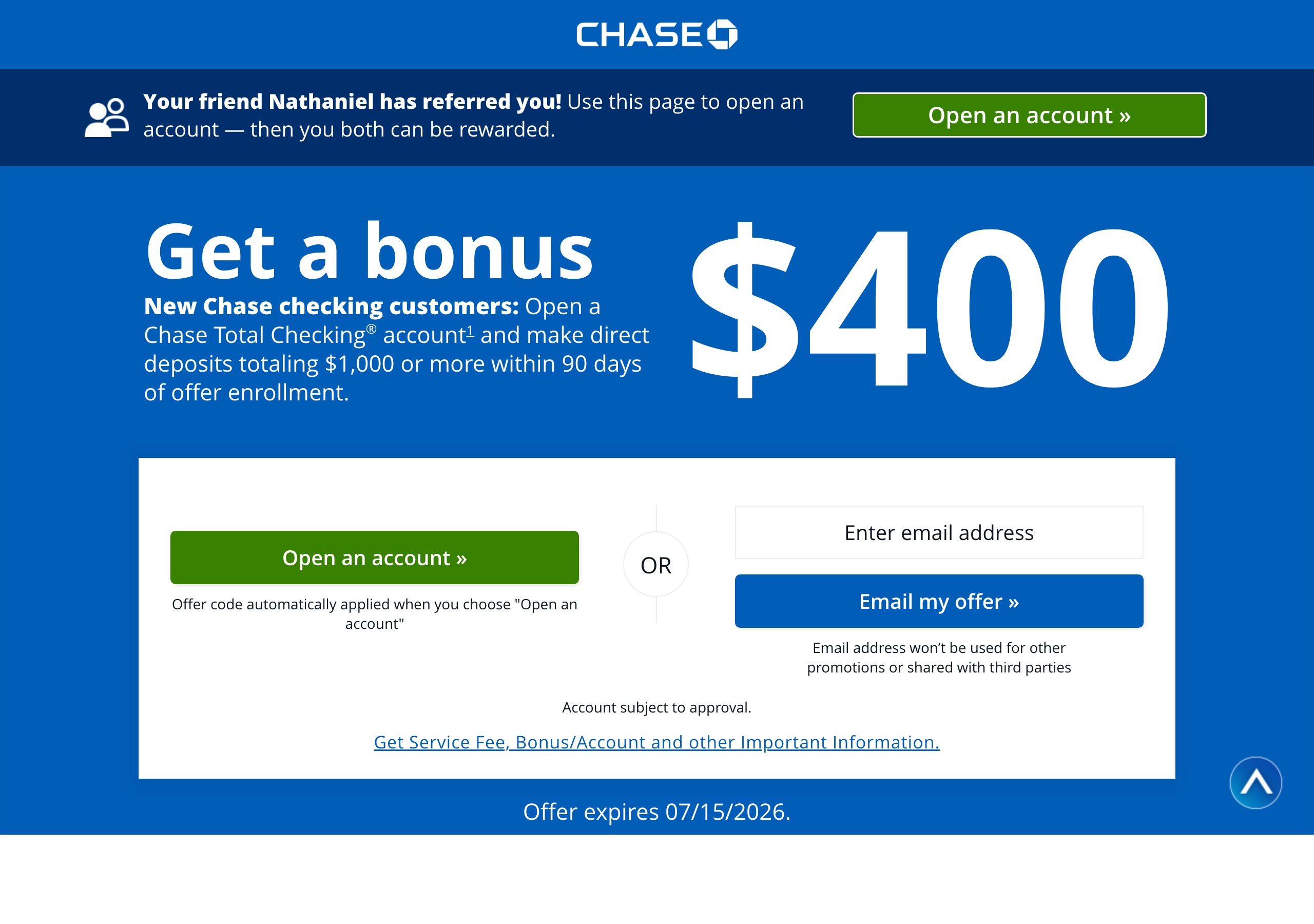
Chase's $400 checking bonus is the gold standard for bank bonus newcomers. Simple requirements ($1,000 direct deposit in 90 days), fast posting (~15 days after qualifying), and Chase's massive branch network make this the most popular checking bonus in the country. If you haven't done this one yet, it should be your first.
Who This Checking Bonus Is Best For
First-time bonus seekers and anyone who hasn't had a Chase checking account in the past 2 years. The low requirements and fast payout make this the ideal starting point for building a bonus rotation system.
How to Maximize This Bonus
Open a Chase Total Checking account using the offer link — this automatically applies the coupon. Route at least $1,000 in direct deposits within 90 days. One paycheck usually covers it. The bonus posts within about 15 business days after your qualifying deposit, which is the fastest of any major bank. To avoid the $15/month fee, maintain $500+ in qualifying electronic deposits per month or a $1,500 daily balance. Offer expires April 15, 2026.
Pros
Cons
How This Compares to Other Bonuses
Chase's $400 is the benchmark. Wells Fargo matches it at $400 but with a 120-day posting time vs. Chase's 15 days. Capital One offers $300 with similar requirements but a 3-year cooldown. Bank of America can go higher ($500) but requires $10,000 in deposits. For most people, Chase should be bonus #1 due to speed and simplicity.
Frequently Asked Questions
What counts as a direct deposit at Chase?
Payroll, pension, or government benefits via ACH, RTP, FedNow, or Visa/Mastercard debit network. Fidelity, PenFed, and Elements Financial ACH pushes are confirmed workarounds. Schwab, Robinhood, and E*TRADE have mixed results. Ally, Alliant, Capital One, PayPal, Venmo, Zelle, Coinbase, and IRS refunds do NOT work. Chase is one of the stricter banks.
How long do I need to keep my Chase account open?
There's no stated minimum holding period, but it's best practice to keep it open at least 6 months. There's no early closure fee.
Can I get the Chase bonus again?
Yes, every 24 months. The cooldown is measured from your last coupon enrollment date, not when you received the bonus.
Does Chase do a hard credit pull?
No. Chase uses a soft pull and/or Early Warning Services (EWS) check. Opening a checking account will not affect your credit score.
Can I do the Chase checking and savings combo?
Yes. Chase frequently offers a $900 total bonus when you open both checking ($300) and savings ($200 + $400 combo bonus). The savings portion requires a $15,000 deposit maintained for 90 days.
Related Bonus Reviews
Full Requirements
Open a new Chase Total Checking account and make direct deposits totaling $1,000+ within 90 days of coupon enrollment. Offer expires 04/15/2026.
Fees
$500+ qualifying electronic deposits, OR $1,500+ daily balance, OR $5,000+ average daily balance, OR linked qualifying checking account.
ChexSystems & Credit Pull
Soft pull/EWS reported. Chase does not pull ChexSystems. Not available to existing Chase checking customers, those closed within 90 days, or closed with negative balance within 3 years. One bonus per account every two years from last coupon enrollment.
Eligibility
Payroll, pension, or government benefits via ACH, RTP, FedNow, or Visa/Mastercard debit network qualify. Zelle, cash, checks, wire transfers, and interest do not. Micro-deposits do not qualify.
Apply
Open Account →Affiliate disclosure: Fat Stacks Academy may earn a commission if you open an account through this link, at no additional cost to you.
Get a personalized bonus sequence, requirement tracking, and deadline reminders — all in one place.
Try Stacks OS →Nathaniel covers the best bank bonuses, credit card strategies, and savings optimization on his YouTube channel.
Subscribe on YouTube →Comments (0)
Fat Stacks Academy may earn a commission when you open an account through links on this page, at no additional cost to you. Commissions do not influence our reviews — we verify offer terms directly with each bank before publishing and do not accept paid placement in our rankings. Bonus offers, requirements, and fees are determined by each financial institution and may change at any time. Always verify the current terms directly with the bank before applying. This content is for informational purposes only and does not constitute financial advice.